
Table of Contents
- Your Career Development Timeline
- Kickstart Your Career Journey!
- Career Coaching Appointments
- Career Toolkit
- Resumes & Cover Letters
- Digital Profiles
- Networking
- Programs and Events
- Exploring Career Pathways
- Research Your Career Options
- Changing Careers
- Applying to PhDs
- Jobs and Internships
- Search for Jobs or Internships
- Job Shadowing
- Avoiding Job Scams
Your Career Development Timeline
Everyone’s career development journey looks different depending on their career goals and the length of their program! Here are some suggestions on where to start and what steps to take depending on the length of your program:
1-Year Program
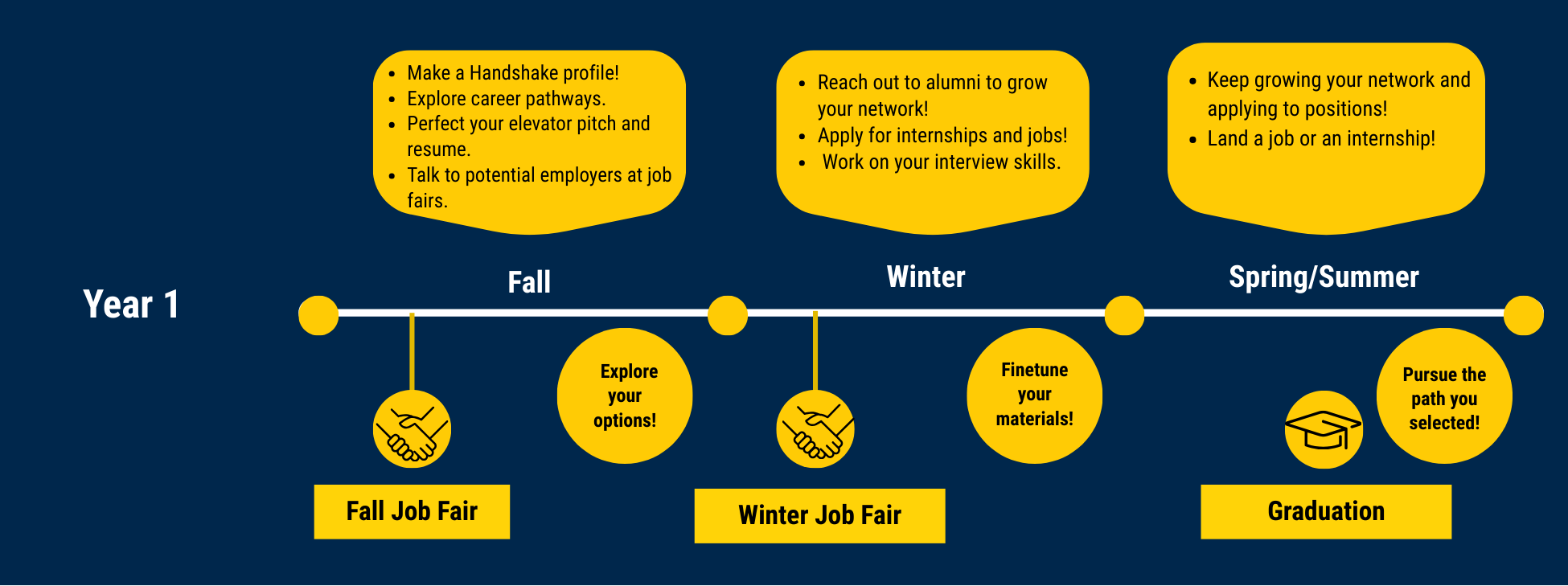
Fall Semester: Explore Your Options!
- Make a Handshake profile.
- Explore career pathways.
- Perfect your elevator pitch and resume, and talk to potential employers at job fairs.
→The Fall Job Fair takes place at the beginning of this semester.
Winter Semester: Fine-tune your materials!
- Reach out to alumni to grow your network.
- Apply for internships and jobs.
- Work on interview skills.
→ The Winter Job Fair takes place at the beginning of this semester.
Spring/Summer Semester: Pursue the path you selected!
- Keep growing your network and applying to positions.
- Land a job or internship!
→ Graduation at the end of this semester.
2-Year Program
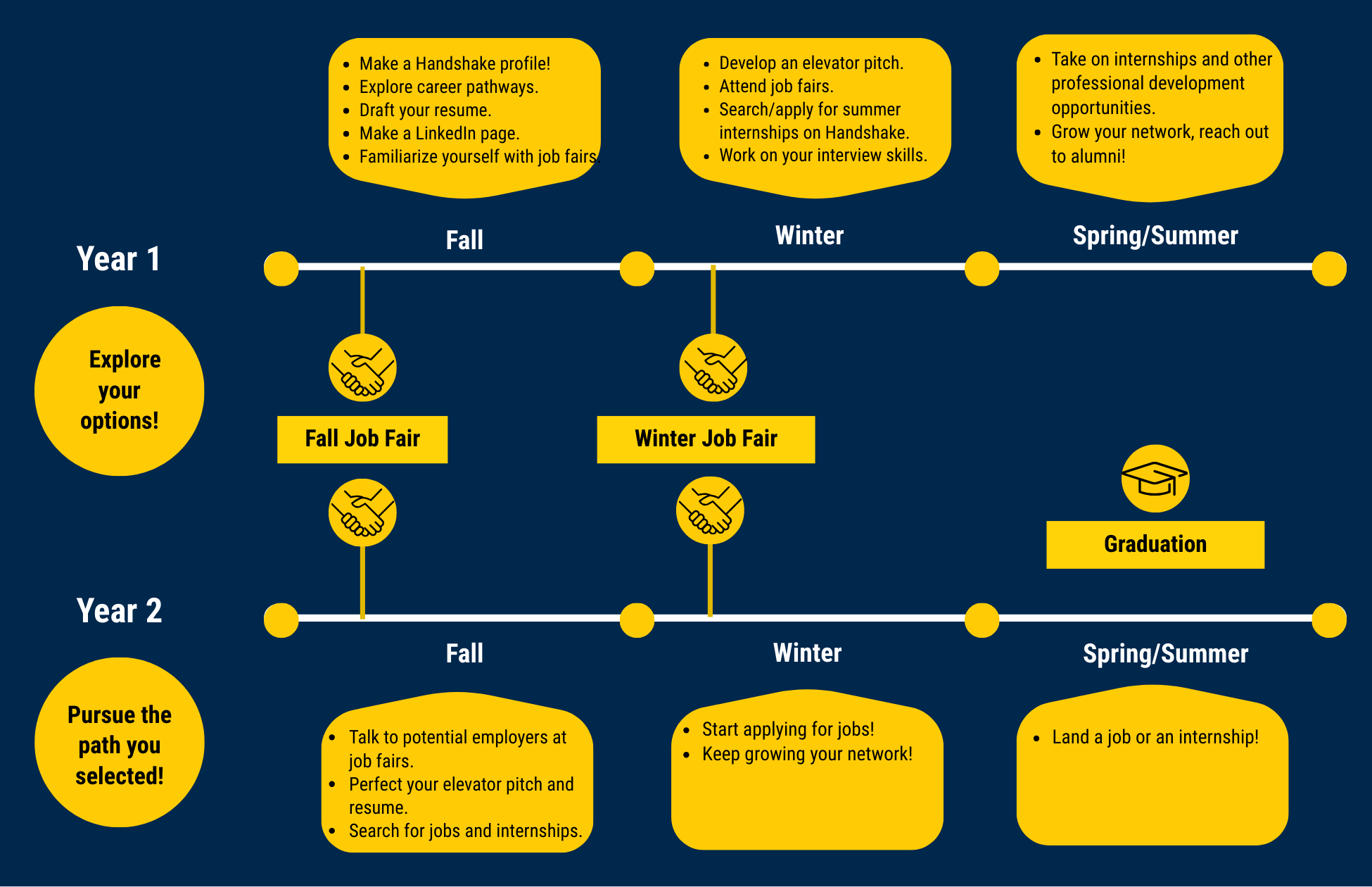
Year 1: Explore your options!
Fall Semester
- Create a Handshake profile.
- Explore career pathways.
- Draft a resume.
- Make a LinkedIn page.
- Familiarize yourself with job fairs.
→ The Fall Job Fair takes place at the beginning of this semester.
Winter Semester
- Develop an elevator pitch.
- Attend job fairs.
- Search and apply for summer internships on Handshake.
- Practice your interview skills.
→ The Winter Job Fair takes place at the beginning of this semester.
Spring/Summer Semester
- Take on internships or other professional development opportunities and grow your network by reaching out to alumni.
Year 2: Pursue the Path You Selected!
Fall Semester
- Talk to employers at job fairs.
- Perfect your elevator pitch and resume
- Search for jobs and internships.
→ The Fall Job Fair takes place at the beginning of this semester.
Winter Semester
- Start applying for jobs and continue growing your network.
→ The Winter Job Fair takes place at the beginning of this semester.
Spring/Summer Semester
- Land a job or an internship!
→ Graduation at the end of this semester.
3-Year Program
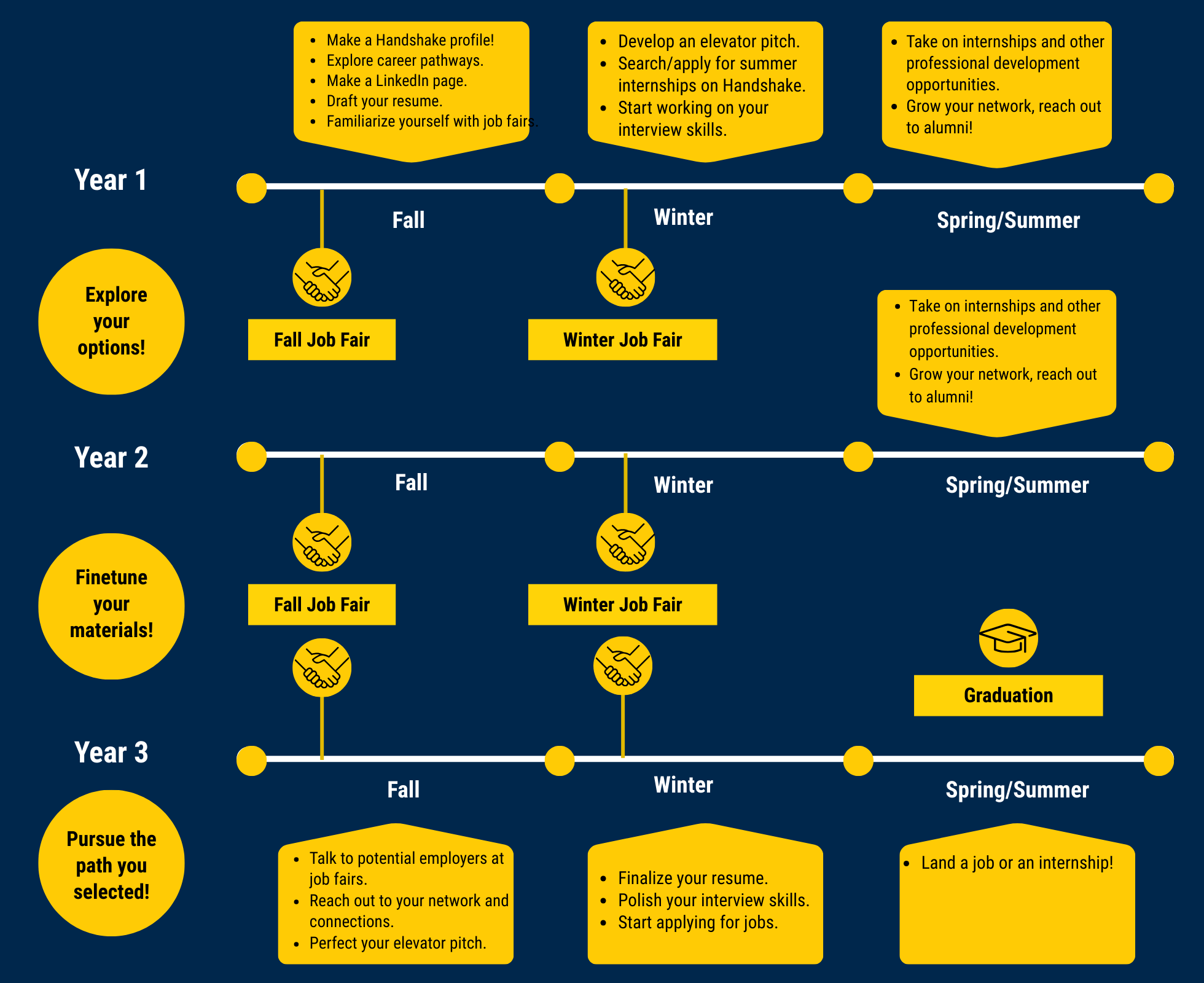
Year 1: Explore your options!
Fall Semester
- Create a Handshake profile.
- Explore career pathways.
- Make a LinkedIn page.
- Draft a resume.
- Familiarize yourself with job fairs.
→ The Fall Job Fair takes place at the beginning of this semester.
Winter Semester
- Develop an elevator pitch.
- Search and apply for summer internships on Handshake.
- Start working on interview skills.
→ The Winter Job Fair takes place at the beginning of this semester.
Spring/Summer Semester
- Take on internships or other professional development opportunities and grow your network by reaching out to alumni.
Year 2: Fine-tune your materials!
Fall Semester
→ The Fall Job Fair takes place at the beginning of this semester.
Winter Semester
- Gain additional experience through internships or professional development and continue alumni outreach.
→ The Winter Job Fair takes place at the beginning of this semester.
Spring/Summer Semester
- Gain additional experience through internships or professional development and continue alumni outreach.
Year 3: Pursue the Path You Selected!
Fall Semester
- Talk to potential employers at job fairs.
- Reach out to your existing network and connections.
- Perfect your elevator pitch.
→ The Fall Job Fair takes place at the beginning of this semester.
Winter Semester
- Finalize your resume.
- Polish your interview skills.
- Start applying for jobs.
→ The Winter Job Fair takes place at the beginning of this semester.
Spring/Summer Semester
- Land a job or an internship!
→ Graduation at the end of this semester.
Kickstart Your Career Journey!
The University of Michigan Career Center offers an extensive array of resources designed to support your professional growth as a master's student. We recognize that identifying the most relevant starting point can be challenging. To make things easier, we encourage you to begin your engagement with the materials outlined in this section!
Career Coaching Appointments
We offer a variety of appointments to support Master's students' professional career development, including job and internship searching, networking, converting your academic CV to a resume, cover letter writing, and interview prep. Book an appointment with the UCC career coaching team through your Handshake account!
In addition to individual coaching appointments, the University Career Center offers a variety of other resources available to all students to support your career exploration:
- Clothes Closet: The Clothes Closet is a program that allows U-M students to obtain business casual and business formal attire from a wide selection of clothing donated by U-M faculty, staff, alumni, and other professionals from the community. Students will also receive tips on how to dress to impress and build their professional brand!
- Self-Service Photo Booth: Students can book free appointments to take professional profile photos to be used to enhance your online presence.
- Community Toolkits: The University Career Center (UCC) is committed to providing resources that support your career development. We encourage you to bring your whole self to this process and explore the various career resources and opportunities available to you.
Career Toolkit
To prepare for your career journey, here are a few career resources you will want to have in your toolkit:
Resumes and Cover Letters
Check out the UCC resources for resume and cover letter writing.
Digital Profiles
Digital profiles are crucial to many steps of the career development process from networking to looking for jobs and internships.
- Handshake is the platform that you will primarily use to book career advising appointments and sign up for professional development workshops at UCC, in addition to searching for internships and jobs.
- LinkedIn is the most commonly used online platform to show and search for career interests, build your network, and explore job opportunities. So, it is important to keep an active and updated profile there since it serves as a hub for professional development.
- UCAN is the University Career Alumni Network where you can search for and connect with professionals who have volunteered to talk with students about their positions and how to break into their industries!
Networking
Building professional relationships during your degree is crucial to starting your career after graduation. All three of the digital profiles featured above are great platforms to connect to professionals in your field equipped with industry-specific career development information and insights.
Here are additional tools and resources to start networking:
- The LinkedIn Alumni Tool - Search U-M alumni to see what next steps people took upon completing your degree program, explore companies and job titles, reach out to alumni for informational interviews and start building your network through professionals who share your educational background.
- UCAN - Connect with professionals who have volunteered to talk with students about their positions to get more information about your desired career path.
For more ideas about how to leverage your connections, visit the University Career Center's networking resources page.
Programs & Events
Throughout the year, the University Career Center offers and co-sponsors programs with Rackham Graduate School. These career focused programs are open to any graduate student. For current program offerings check out your Handshake account through the University Career Center and Rackham Events Calendar. You can also request a program for your class or organization.
We offer a variety of programs throughout the semester, including workshops on interview technique, cover letter and resume writing, networking skills, and more. To see an up to date listing of our workshops and to register, view our graduate resources document. Check out these sources for group presentations and workshops that will help you prepare for your job search!
Exploring Career Pathways
It’s not always transparent what career paths your Master’s degree can lead to, especially given that positions and job titles can be really confusing without prior familiarity to the industry. It is important to explore a wide array of career options based on the skills you acquired throughout your Master’s and the aspects of your studies that you enjoyed the most.
You can use the resources and the information in this section to start exploring different career pathways, internships, and jobs.
Research Your Career Options!
Exploring your career options involves gathering and evaluating information about you and the many career options. In order to find what fits, you first need to know your story, your skills, strengths, values, and experiences. Second, you need to know about the careers you are considering. There are so many different ways to explore career options, be creative in how you choose to investigate your options!
- Career Tracks - Sign up for a track to get personalized events and job/internship postings emailed to your inbox.
- Informational Interviewing - Get insight on industries straight from people working in those fields.
- U-M GPT - GenAI can be a useful tool to learn about different fields. Consider prompts like "Tell me about x field?", "How do you break into that field?", and "What skills are needed?"
You can also benefit from tools that are not specifically designed for Master’s students! Especially if you started your degree with a clear career path in mind but ended up changing your mind during your degree, you can check out this page to browse different career paths related to your field: What Can I Do With This Major?
Changing Careers
If you are considering changing careers after your Master's, or you pursued a Master's degree to change careers, know that you are not alone! Many people pursue Master's degrees to change careers and pivot to an industry different from their undergraduate degree. It is also not uncommon for people to decide to change fields and careers during their Master's once they get a closer look into the industry or academia within their field. We have some resources to help you navigate this shift!
- Take time to access and understand the reasons behind this pivot. Are you interested in better-paying job opportunities, more job stability, better work-life balance, better mobility, different career growth opportunities? Have your professional interests and priorities changed?
- Check out career assessment tools by the UCC to explore your options.
- Consider your transferable skills. It is very likely that you can utilize your previous academic or professional background in a way that will make you stand out in the new path that you choose.
- Utilize networking resources at the UCC to reach out to U of M alumni with similar academic backgrounds who are currently working within the industries that you want to target and gather more information on the requirements and the responsibilities of different roles.
- Check out graduate certificate programs within U of M to branch out your professional skills.
- Consider booking a career coaching appointment at the UCC for career exploration.
Applying to PhD Programs After Your Masters
Many Master’s students decide to pursue a doctoral degree for career opportunities in academia, research-heavy careers within industry, or simply following their passion for research in their field!
If you decide that your next step is to pursue a doctoral degree, visit our Applying to Grad School page for in-depth information and resources about how to search for programs, what to consider before applying, and how to prepare for applications.
Jobs and Internships
Search for Jobs or Internships
Whether you're beginning your job search or your internship search, it's important to know where to start. Check out our resources to give you an idea of how to get going and where to focus your attention and time to be most effective:
- Check out Handshake for jobs & internships and to explore career options.
- You can also use the groups you have been contributing to on LinkedIn as a valuable referral source. Check out this article: Using LinkedIn to Find a Job or Internship.
- Search for Jobs or Internships - Learn how to successfully strategize your job or internship search.
Check out other online job posting platforms to broaden or narrow down your search:
- American Alliance of Museums: Offers a job board for all museum professionals.
- American Association for the Advancement of Science: Career and job posting portal for engineers and scientists.
- American Historical Association: Jobs and professional development resources for historians.
- American Association of Immunologists: Career opportunities for immunologists.
- Handshake: The Career Center’s job/internship posting portal.
- HigherEdJobs: A job portal for positions in higher education and research beyond faculty positions.
- Idealist: Jobs, internships, and volunteer opportunities in nonprofits.
- Interstride: Explore international job postings and see what companies have a history of sponsoring visas.
- National Association of Independent Schools: Offers job listings for independent K-12 schools.
- National Council on Public History: Job board, news, and events for history professionals.
- NatureJobs.com: Science job posting portal.
- New York Foundation for the Arts: Offers a job board for working and emerging artists.
- Publishers Marketplace: Offers a job board for a range of positions in publishing.
- The Chronicle of Philanthropy: Offers job listings within the non-profit sector.
- The Muse: Job board and tips on everything from writing a cover letter to dressing for success.
- U.S. Jobs: The Federal government’s official jobs site.
- Vitae: Chronicle of Higher Education's academic and non-academic job and career advice portal.
Job Shadowing
Job shadowing is a short-term experience that can last an hour or a day that allows you to learn more about careers or occupations that you are interested in. It can help you in your career decision-making process by allowing you to experience a career first-hand to see if it might be a good fit for you.
How Do I Job Shadow?
First, pick a career that interests you. Next, find a person who does that job (think of friends, relatives, professional contacts, or even U-M alumni!).
Explain to them that you would like to learn more about their occupation and whether you could shadow them for a day (or specific period of time) to get a feel for their day-to-day tasks and the atmosphere on the job.
Avoiding Job Scams
New graduates, particularly international students, are often targeted by fraudulent services that seek to illegally acquire your money or personal information. We urge you to review the information below to learn how to recognize a scam and what steps to take if you become a target.
For more information, check out our page on how to spot and report fraudulent employers and job postings.
Keep in Touch
Be on the lookout for our University Career Center Master's newsletter that should be landing in your inbox biweekly. We highlight upcoming career development programming, as well as a selection of jobs and internships. If you aren't receiving it, please reach out and let us know.
Kirsten Elling, PhD, Assistant Director for Graduate Career Development
Anna Wagner, EdD, Career Coach for Graduate Students